Friday, July 12, 2013

Another sister for Chester: Almeda Arthur Masten

A couple of months ago I came across a bit of information that interested me. When I decided I wanted to blog about it, I realized that I had no idea where I found the tidbit. That meant I had to re-trace my cyber steps.

I quickly found a copy of the Spindle City Historic Society newsletter  from 2009. The parenthetical statement read "Masten was married to Almeda Arthur, the sister of Chester A. Arthur, the 21st president." The article in question is a quick 2 paragraph history of Cohoes Music Hall founded by James H. Masten (husband of Almeda) & William Acheson. A quick catalog search at my new job (Rensselaer Public Library) revealed a dissertation about the music hall from 2008 & a history of Cohoes by an Arthur H. Masten, both available at the Albany Public Library. I will be visiting the local history section there in the coming weeks to see if there is any information on Almeda lurking in the pages. (I'll keep an eye out for anything to do with Mary & her anti-suffrage group as well.)

Now what about the author? The one who wrote a history of Cohoes? Arthur H. Masten is the son of Almeda & James. He was a lawyer & local historian who wrote a few books. Aside from the a fore mentioned volume, Arthur also penned The Tahaws Club: 1898-1933 (1935) & The Story of the Adirondac (1923). His papers regarding these publications are in the collection of the library at the Adirondack Museum. Upon looking at the finding aid for the younger Masten's papers on the NY State archives website, there doesn't appear to be much in the way of personal documents. However, it may be a worth a trip to Blue Mountain Lake. I'll have to give them a call.

Another trip I should make is to Albany Rural Cemetery where Chester, & his wife Ellen are buried along with, you guessed it, Almeda & James Masten, as well as, Mary & James McElroy.

James H. and Almeda Arthur Masten grave stones*

As is the case with researching 19th century women (& many other time periods), primary source material can be hard to come by. Women rarely left behind evidence of business transactions unless they were widowed. Often times women are referred to by their married name in official records. In Almeda's case that would be Mrs. James H. Masten. Luckily I know her husbands name & I should be able to find her, should she be listed in a record.

I am hoping through finding records on her husband & son that it will enable me to find out more about her & the life she lived.

*Photo taken by Don & posted on Find a Grave. To view the original: http://www.findagrave.com/cgi-bin/fg.cgi?page=gr&GRid=111135305

Tuesday, July 2, 2013

For the Love of History: A Reluctant Historian

As I was boxing up office supplies, books, artifacts, & records today, with the help of my mom, I started thinking about why I became an historian. It wasn't some "higher calling." I hadn't fantasized about it when I was a kid. I kind of fell into it. It took my by surprise, hence why I consider myself a reluctant historian.

Boxing up and moving

I always wanted to be a "rock star," well a singer, at least. I would dance & sing around the side yard, which I can see from the picture window as I write this. I pretended I was on Kids Incorporated, where I was in love with Ryan (Lambert). Martika & Mario Lopez were my other 2 favorites, even though Mario was only a dancer. I sang songs by Wham!, Taylor Dayne, Paula Abdul... I was very upset when the show went from Saturday mornings on NBC, to the Disney Channel in 1986. Even though the village of Greenwich got cable in 1981, my house could not get cable until 2013 (Yes, this year folks).

I started ACC as a voice major & had a great time. I learned a lot & made some great friends, many of whom I am still friends with today. When it came time to transfer to a 4 year school, I also had to pick a major, as I had convinced myself that voice was no longer an option. I chose history, because I could study music history, art history, women's history... Everything has a history!

One of my classes at SUNY New Paltz was called Hudson Valley Culture. It was basically a local history class centered around the lower Hudson Valley. It was the 1st time I really learned about a very specific region & I loved it. Then my parents came down for a visit & we went to Samuel F.B. Morse's home, Locust Grove. Taking that tour & walking those grounds solidified my love of history & old houses & the people who lived in those houses.

After I graduated with a BA in History, everyone asked what I was going to do with my degree. "Teach?" was the usual. I never wanted to be a teacher, I wanted to work in a museum. Well, tour guides & curators are teachers. So, the joke was on me. I taught, I mean worked, in a bunch of different museums, but I tried to stay true to my original interested. I spoke about women, music, art. I learned about architecture & furniture styles. I loved the houses & miss them like old friends I don't see very often.

Many people, when asked what their favorite time of work is, would say quitting time. When I worked in a house museum, my favorite time was the morning, unlocking the doors, turning off the alarm, walking through the rooms opening blinds, shutters & curtains. Walking up the stairs to the bedrooms, where everyone would have been getting ready for the day. The dust motes dancing in the sunshine. The promise of interested visitors.

I felt some of that today as I began moving from my old office on the main floor, to my new office upstairs. The Town Office building used to house the Washington County Home for Aged Women & walking through those rooms that house board rooms, a food pantry & the clothes closet, I could still imagine the women in their rooms. I wonder how many women stayed in my new office over the years?

I still sing when I can, weddings & funerals. I torment my daughter by singing along with her One Direction CDs when we drive in the car together. & I am developing a program involving music & the suffrage movement. I hope to sing it for you someday.


I apologize if this is not what you have come to expect for my blog. One thing I like about them is that, no matter the subject, blogs are personal. It's like journaling to a specific audience, that you hope is listening.

Friday, June 21, 2013

The state of New York State historic markers in Greenwich

You've seen the blue & yellow roadside markers around the area. Greenwich even has a few brown & white ones. But we don't have very many.

The state started the historic marker program in 1926 to commemorate the sesquicentennial of the Declaration of Independence. The program continued, with state funding, through 1939. This explains why so many of the markers relate to the American Revolution, like the 2 below.

Located on Dix Bridge Rd in Clarks Mills


There are other historical markers around the town, but they were not put up by the state. State funding was removed from the program, but it was not abandoned. The state just decided that the municipalities should foot the bill for these expensive roadside sentinels. 

At the corner of Woodlawn Ave & Fisher St near the school

The Washington County Historical Society put up some markers, like the 2 below.

Near Dix Bridge at Hudson's Crossing in Clarks Mills
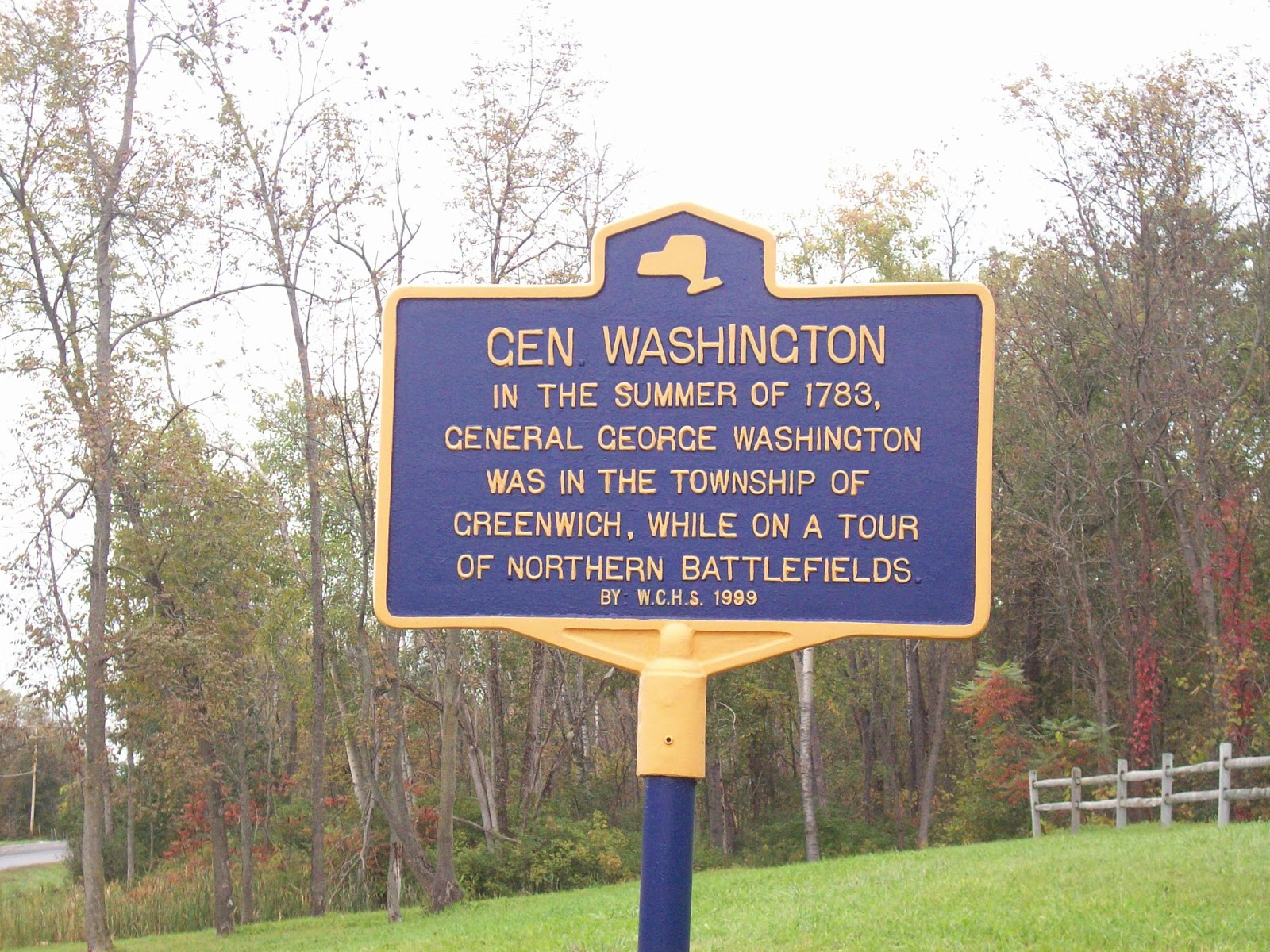
George Washington marker on US Rte 4 just before County Rte 77

Then we have some other markers. Like the plaque in Battneville put up by the Ondawa-Cambridge chapter of the Daughters of the American Revolution (DAR). It is inserted into a stone wall & is nearly impossible to read from the road. The sign is easier to see, but it is still not a historic marker. Susan B. Anthony & her family need a proper marker at their former home.

"EARLY HOME OF A GREAT WOMAN" the plaque reads

Sign outside the house on Route 29 in the hamlet of Battenville

& what about those brown & white markers? Aside from being ugly, they are harder to read than the blue & yellow ones. Who put these up, & when?

Not a very descriptive marker- along US Rte 4 near the Washington marker

Located at the intersection of County Rte 77 & Lick Springs Rd

The long & short of it is that we could erect some more historic markers in the town without shelling out our hard earned cash. The William G. Pomeroy Foundation has an historic roadside marker grant program. Starting on August 1, 2013 the grant application will be available for our region (APHNYS Region 5). If we choose a site or 2, & provide all of the necessary paperwork, we could receive the funding.

Any ideas? I was thinking the Anthony home in Battenville, the Main St. former site of the Free Church, founded in 1937 by Hiram Corliss, or the site of Union Village Academy.


Friday, June 7, 2013

Brief history of Eddy Plow

A few years back I received an email with pictures of an Eddy Plow. The owner felt the need to paint (gasp) the metal & display it on their lawn. (BTW... don't paint antiques/ historical pieces until you talk to an expert.) The second image shows the business stamp. "___ Plow Co Greenwich N.Y."

Plow in question

Plow from Greenwich, NY

Perry Miller was the first to manufacture plows in the Greenwich/ Easton area. According to Mrs. B.F. Sharpe, in History of Greenwich NY, Mr. Miller "made the second cast-iron plow in the country" (p. 12). By 1830 his sons Hill & David were no longer in the plow business.

Enter Corinth (Saratoga County) native Walden Eddy (b. 1807). Mrs. Sharpe writes on pages 12-13
In 1832 Walden Eddy began the manufacture of plows, having a pattern which became justly celebrated afterwards  as the old "Rough and Ready wrought iron beam," and it is believed that from this source have originated all the wrought-iron plow-beams in the country. Mr. Eddy also invented a shovel plow that has large sale.
 The plow works was located in the village of Greenwich (at the time of founding, Union Village), but on the town of Easton side along the Battenkill. The three-story building still stands & has been renovated recently by Patrick Brereton.

In an article from the Greenwich Journal, date January 19, 1983, the population of the town is listed at about 1,000 when Eddy started making plows in 1832. Lack of convenient shipping (no canal on the Battenkill, no railroad until 1870), & lack of the latest technology are lists as reasons for the floundering foundry with Mr. Dyer. Enter Abram Reynolds, & a few years later, Samuel Langdon. Eddy, Reynolds & Langdon did rather well & then Mr. Eddy bought out the other 2 men. I'm assuming this was so he could bring his sons into the fold, because in 1881 Oscar H., Walden G., & Fred W. entered the business, & the name was changed again to W. Eddy & Sons.

Based on this same article, it appears that the present three-story Eddy Plow building was build in 1892 with 60 feet of frontage to Eddy St & incandescent, electric lights powered by their own plant. It even has a full basement "considered one of the finest in Washington county." The building had a showroom, moulding room, plow mounting & grinding room, as well as blacksmith, forge, machine paint & finishing shops. The article says the plow work employed 40 men including William McCall (head of the moulding room) & W.T. Liddell (business manager).

Apparently the "rough & ready" trademark is "NO. 4 s". In 1891 they introduced a steel reversible level land plow, & in 1892 a one horse plow with patent draft rod, perfect for gardening, & orchards. They were also selling an improved marker for corn & potatoes, a hilling plow, also for potatoes, rye thrasher, land roller, & horse hoe & cultivator, among other things. At one point they even made & sold bicycles.

Eddy Plow Works Calendar 1931

In 1908 the business was incorporated . A major fire in 1918 cut production & business fell off. On October 10, 1923, the Greenwich Journal reported that the W. Eddy Plow Company filed for bankruptcy at the federal court in Utica, NY.The fire had hurt business, but the Great Depression mad matters worse. Liabilities were listed at $79,072 (using the Consumer Price Index this is the equivalent of $1,060,000 in 2012). According to the Greenwich Journal, the plow works was sold at auction in December 1923 to Mac Finn of Saratoga Springs, NY for $16,500.

References:
"W. Eddy & Sons: An Enterprise of Greenwich Sixty- Years Old, The largest Implement Manufacturers and Dealers in Eastern New York." Greenwich Journal. January 19, 1893. 
"Plow Company Files Bankrupcy Petition." Greenwich Journal. October 10, 1923.
"Mac Finn Purchaser of Eddy Plow Plant." Greenwich Journal. December 19, 1923.
Gill, I.V.H. The Greenwich Community of 1850. 1953.
Sharpe, B.F. History of Greenwich. Greenwich, NY: Commonweal Press. 1909.
Tefft, Grant. The Story of Union Village, Volume 1. Greenwich, NY: Greenwich Journal. 1942


Friday, May 31, 2013

Whipple City Days are coming!

The 34th annual Whipple City Days  event is a local tradition. This year I will be in Dorr Park (Main St & Cottage St) with (hopefully) a number of other groups representing local & regional history.

So, I thought I would share with you some memorabilia I have in my office.

Button from Whipple City Days past

Program from the 1985 Whipple City Days

Below you can see the entire program from the 2nd Whipple City Days June 24th- 28th, 1981. The parade, road race, craft fair, & music in Mowry park are still present all these years later. Also, the ever popular Greenwich Free Library Book Sale! (My personal favorite.)


1981 Whipple City Days program

1981 Whipple City Days events
What happened to the tennis tournament & the revolutionary War encampment? Oooo, & the bike race!

The Greater Greenwich Chamber of Commerce will put on a great event. Hope to see you there!

Download this year's event schedule here.

Friday, May 17, 2013

St. Joseph's Cemetery

As I was snapping some pictures at Greenwich Cemetery last week, I realized I had never been in St. Joseph's Cemetery before. & it is just across the road. So, after work, I drove over & snapped some pictures there. I didn't realize how large it was, & that you can see the high school. I use to run cross country (for Schuylerville) around the cornfield on the other side of the cemetery fence.

Now for a bit of background provided by Joseph L. Shannon, who wrote Saint Joseph Parish Greenwich, New York in 1978. This book is available for research at the Greenwich Free Library & Crandall Public Library in Glens Falls (all copies are non-circulating).

History of St. Joseph's

Albany Catholic Diocese established April 1847
Visitation Catholic Church, Schuylerville founded 1847
St. Patrick's Catholic Church, Cambridge founded 1853
St. Joseph's Catholic Church founded 1870

The plethora of mills in the area brought immigrants to rural areas upstate.  In 1865, 80,000 of the estimated 134,000 Catholics living in the area covered by the Albany Diocese were Irish immigrants (Shannon, p.8) escaping the Great Potato Famine. When the Greenwich Dunbarton Mill opened in 1879, many of the 200 workers were Catholic (Shannon, p.4).

Shannon states "After the Mass of 24 January 1869, which marked the opening of the Mission of Greenwich, until the first Mass offered in the building now call "St. Joseph [sic] Church" 24 July 1870, the Fathers from Cambridge held services in various places in Greenwich" (p.15-16). The only other option was to travel to Mass in Schuylerville, Hudson Falls, Salem, or Schaghticoke.

St. Joseph's first resident pastor & proponent of the Temperance Movement, Fr. Thomas A. Field, was the one who set about founding the St. Joseph's Cemetery. Shannon writes "By Deed,  dated  6 November 1881 (Book 91, page 30) Fr. Field purchased for $1,000 two parcels of land, one  of sixty-seven acres and the other of one acre on the northern edge of the village of Greenwich from Charles Stevens and his wife, Sarah A. Stevens" (p.44).

Some of the artistry on the tombstones in St. Joseph's

The first burials (& tombstones) appear to be transferred from other cemeteries as the deaths predate the founding of the cemetery. The oldest date is 1863 (Shannon, p. 45).

Well, St. Joseph's is just a peaceful as Greenwich, except for the neighbor's dog who decided to bark at my car. But even (s)he didn't sound too upset by me being there.

St. Joseph's Cemetery, Greenwich, NY- 10 May 2013


Friday, May 10, 2013

The Greenwich Cemetery

We have 32 cemeteries in the Town of Greenwich, the largest is, of course, the Greenwich Cemetery nestled between Main St & Cottage St. Over 10,000 people have been interred in this peaceful spot & the Greenwich Cemetery Association does a great job of keeping it nice.

I've never found cemeteries to be creepy, or scary. I've always found them tranquil, thoughtful. As an historian & lover of history, I have been to many cemeteries. My sister & I visited Lincoln's tomb in Springfield, IL when we traveled across the country in 1995. (Yes, we rubbed his nose.) I keep meaning to go to Albany Rural Cemetery to visit Chester A. Arthur's grave.

However, most of the time, I go to a cemetery to look at the graves of non-famous people, like my relatives, or random people with interesting stones. Typical iconography like weeping willows, winged angel heads & urns are typical on early New England headstones. I saw a number of these in Salem, MA last fall. A good example of the willow motif can be found here in Section F.

Greenwich Cemetery May 2013

As a kid, my younger sister & I use to ride our bikes over to the Riverside Cemetery in Fort Miller. There are a number of large pine trees shading the ground, plus it was next to the Hudson. It was always cooler there, so it was the perfect spot after a hot, dusty bike ride. Reading the stones made me appreciate my life a bit more, especially when we noticed the markers of children who died young.

Before my daughter started school, she & my mom use to visit my dad while he was working at St. Mary's Cemetery in South Glens Falls. She would lay under the trees on a quilt & say the trees were talking to her. They we eat lunch, picnic style, then head home.

The idea of picnicking at a cemetery may seem odd to some, but it was very common in the 19th & early 20th centuries for many of the reasons I have stated above.

Cemetery picnic early 20th century
If you are looking for ancestors buried in local cemeteries, check out the books put out by Historical Data Services. The Greenwich Free Library has non-circulating copies in the Gill Room. I also have a few of them in my office for research, so stop by on a Friday morning.

Also, check out Find-A-Grave. It is a very useful website to locate burial information throughout the country.

Friday, April 26, 2013

Greenwich & Johnsonville treasure

Yet again, at a loss for what to blog about this week (not because nothing comes to mind, but because too many do & I can't choose), an envelope on my desk this morning provided the answer.

A train ticket collector in California sent me 2 Greenwich & Johnsonville Railway Company tickets! They are tiny & stained but otherwise in great condition. Based on the information in David F. Nestle's book Rails Along the Battenkill: A History of the Greenwich & Johnsonville Railway (Is the title a play of Drums Along the Mohawk? I digress.) I can estimate the dates of the ticket...

The oldest ticket is numbered 20791 & has the signature of J.H. Thompson who was Superintendent in 1897. The other ticket is numbered 26824 & signed by J.H. Mc Daniels. Mc Daniels was Superintendent from at least 1901-1912.

Greenwich & Johnsonville Railway ticket c. 1897


For more information I highly recommend Nestle's book. It is very readable & has quite a few interesting images of engines, bridges, maps & railway ephemera like tickets & schedules. I have referred to it before, but now I am actually reading it!

Highly recommended book on the G&J
 

Wednesday, April 24, 2013

Happy Anniversary

I just wanted to say that today marks my 10th anniversary of being the appointed Town Historian of Greenwich!

Thank you all for your questions, comments, likes on Facebook... Inviting me to present a program to your students, or group...I really appreciate being able to serve this wonderful community for the past 10 years!


Friday, April 19, 2013

Sesquicentennial in Greenwich: 1959

Sesquicentennial Banner - Greenwich, NY 1959
In 1959 the village of Greenwich, NY hosted an elaborate Sesquicentennial celebration, complete with two parades, & a pageant called "Whipple City Grows."

Front page of Whipple City Grows and ticket stub

The schedule of events is listed in the center of the program above.

Saturday, August 1, 1959 was Sesquicentennial Parade Day which included the parade from 2:30 to 4:30 p.m. & the Queen's Ball at the high school from 9:00 to midnight.

Sunday, August 2, 1959 was Religious Dedication Day with all of the local churches hosting special services in the morning & an interfaith service at 8:00 p.m.

Monday, August 3, 1959 was Youth Day- filled with baseball, softball, swimming, & an "Outdoor Street Dance."

Tuesday, August 4, 1959 was Agricultural Day featuring a hay ride, square dance, old-time farm equipment & exhibits by the Farm Bureau, Soil Conservation, the Grange, 4-H, & others.

Wednesday, August 5, 1959 was Ladies' Day (sorry fellas). This included a luncheon, a reception, a dinner for Lt. Governor Malcolm Wilson, a fashion show, & the crowning of the "Sesquicentennial Queen." 

Thursday, August 6, 1959 was Homecoming Day with open houses at the various churches & fraternal organizations like the Independent Order Of Fellows

Friday, August 7, 1959 was Industrial Day which included guided tours of local industries. Plus, the final judging of the "Brothers of the Brush" beard growing competition ended with a shaving contest!

Saturday, August 8, 1959 was Fireman's Day. The week of festivities concluded with the Washington County Fireman's Parade at 2:00 p.m. & the final of 4 performances of "Whipple City Grows"!

Sesquicentennial book and Washington County VFA Convention Program

Housing Committee badge
Some Housing Committee documents still survive. Then, as now, there was little accommodation for out-of-town guests. So, the committee members were in charge of finding housing for people coming to town for the week long celebration. Marion Harrington was the Housing Committee Chair.

Wooden nickels- one with the Sesquicentennial logo 1959
When we held the Town of Greenwich Bicentennial in 2003, & the Village of Greenwich Bicentennial in 2009, I looked into having wooden nickels done, but the funds just weren't there. I did have a wooden nickel collector call me though. The gentleman told me that he would buy a bunch of them if we decided to do it so he could trade & sell with other wooden nickel collectors! (Who knew...)

Friday, April 12, 2013

Historian vs. Archivist

As some of you may know, I am working on my Master's of Science in Information Science from the University at Albany, SUNY. (Information Science used to be called "Library Science" not too long ago.) My focus is on Archives & Records Management & I am currently interning at the NYS Archives in Albany.  & thinking about what to blog about today, I realized that many of you may not know what an archivist does. You may not even know what an historian does.

So, I did what most of us do in this day & age, I "googled" it.

The definition of an historian: a student, writer, chronicler of history

The definition of an archivist: one who is in charge of an archives & its collection

Didn't we learn in grade school not to define a word by using the word? These definitions are vague & flawed, but I think you get the idea. An archivist cares for, describes & preserves records, documents for posterity. An historian uses those documents as evidence to prove, or disprove, the point of their writing.

As a public historian, I am not supposed to amass a collection* of documents pertaining to Greenwich history. I am supposed to look at those records, read, study, synthesize, then write & talk about Greenwich history. This blog is one attempt at that.

Recently, I received a package of documents pertaining to the United Presbyterian Church of East Greenwich. Mostly they are bits of ephemera that, singly, may not amount to much, but as a whole could be useful to someone studying local churches or local businesses. I plan on transferring the documents to the Gill Room so that they can be accessible to researchers. Here is a taste...

Documents relating to the UP Church of East Greenwich

*Many of my colleagues do because there may not be a suitable repository available.

Friday, April 5, 2013

Preparing for the big move...

It appears spring has finally sprung, as it always does, here in Greenwich. Just this morning traffic was backed up from the Mowry/Corliss/Main intersection to Cottage Street behind the street sweeper. Kids & adults alike were walking to the Greenwich Free Library without winter coats.

My new office is coming along nicely, but my packing is not. Every time I decide to look through something with the intention of putting it into a box, I come across really cool stuff. Stuff that must be perused & read right now!

Today, was just such a day. I opened the Historic Resources Survey boxes to see if there was anything on Riddle Road to aid in an e-mail inquiry (just a nondescript record on The Owl Pen) & realized that there was a wealth of information in those boxes. Plus, I need to go through & put the records in folders & label them. That will be my project next week! Oh, the survey was done in preparation for Greenwich's nomination for Historic District designation from the National Register of Historic Places & the National Park Service. Check it out here.

I found some information regarding the Lowber Lime Kilns in Bald Mountain & Old Lock 12 of the Champlain Canal. If any of you have been on the Facebook page you have seen the photo I posted, but there were a few others.So I ran them trough my new app "Photo Grid" & voile!

1981 images of the Lime Kilns with a 21st century shot of the marker

Mash-up of 1981 images and my 2009 photos

I also found some interesting historical "papers" included in the survey that I will be reading & sharing with you. An obituary on Ann Caroline Holmes (nee Mowry) really caught my attention. More research is needed there I think!

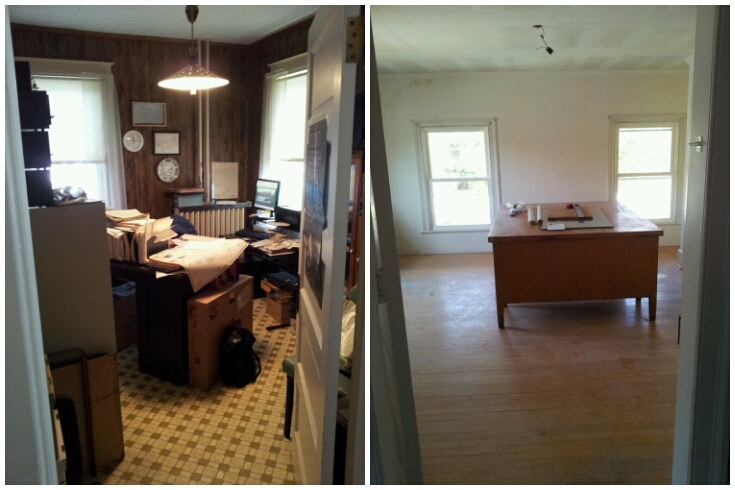
I'll leave you with images of my new/ old offices. I haven't been this excited since I got upgraded from Windows 3.1 to Windows 98! (Now I have Vista.)

work in progress- new Historian's Office upstairs

current vs. new- so much bigger


Friday, March 22, 2013

Cleaning out ye olde desk

It appears to be official that I am getting a new office here in the Town Office building. The roof/ceiling situation has been fixed, the hideous wallpaper removed... I have chosen a paint color- Liberty Park. That was fun.

Now on to the un-fun part. Duh, duh,duh, duh... cleaning out my office. More precisely, cleaning out my desk. (& yes, I know un-fun is not a word.)

Some random bits I discovered in the 13 drawers of my desk

Old office supplies and unused paper
I was able to consolidate the 13 drawers down the 4. I have boxed up all of the excess office supplies. But wait... I found something cool!

Books of voters in Greenwich
These "Enrolled Voters" books are very interesting. They list the name, address & political party affiliation (if any) of all registered voters in the town by district. I have books for the following years: 1935-38, 1941-45, 1947-61, 1963, 1965. Also in the drawer : Easton "Enrolled Voters" 1938, Washington County "Enrolled Voters" 1960, 1964.

Of course, I had to check. It was great seeing my grandparents & great-grandparents names in the books. No matter the party, I'm glad to see that they all were registered voters! My mother is not listed because the age limit for voting was not lowered from 21 to 18 until the states ratified the 26th Amendment & President Nixon signed it into law in July 1971.

Don't forget that my office hours are Fridays 10:00-Noon. Stop by & say "Hi."

Friday, March 15, 2013

Random Artifact Day

I have dubbed today "Random Artifact Day." This is mainly due to the fact that I had no idea what to blog about. Luckily my office is filled with really cool stuff.

C.M. Stevens clothes hanger

Like the clothes hanger. I told you it was random. As you can see from the close-up below, this clothes hanger is from C.M. Stevens, Greenwich, N.Y. The information on a sticky note I have since removed reads as follows... "1926- C.M. Stevens was a man's clothing store Later owned by Ray Dwyer Sr after Dwyer, Robert Pratt Now Karate training place 1/10/97 James F Catalfimo"

close-up
Looking in the 1966 Schuylerville-Greenwich phone book I have here in the office, I found this listing in the advertisement section...

Close-up of 1966 phone book- Pratt's Clothing Store

Pratt's Clothing Store was located at 109 Main St. & still in operation in 1966! In the 1970-1 phone book Pratt's is listed at 120 Main St & was still listed in the 1985-6 phone book. I will have to look through the binders complied by my predecessors & see if there is more information about this store. Feel free to comment here on on the Historian's Facebook page with any memories you might have!

Friday, March 8, 2013

Get out of the house & into some history

I don't know about you, but February & March can get me down. Waiting for the leaves to burst open in that pretty spring green. Willing the crocuses, snowdrops & daffodils to push their way up through the gray snow & dead leaves. Then you get days like today, snow on top of mud.

Snowfall in Greenwich March 8, 2013
So, how about you get out of the house & go visit some local museums.

Here are just a few of my favorites:

 The Hyde Collection on Warren Street in Glens Falls. It is a world class art museum right in our own backyard.

The Old Fort House Museum on Broadway in Fort Edward. They are only open by appointment during the winter & spring so get a group together & give them a call to set up a time. Executive Director & Town of Fort Edward Historian R. Paul McCarty is also presenting a program on Solomon Northup at the Courthouse Community Center in Salem on Thursday, March 21 at 7:00 p.m.

The Frances Young Tang Teaching Museum and Art Gallery at Skidmore College in Saratoga Springs. I think I might just take my daughter there this weekend. The student curated exhibit Crowded looks particularly interesting.

The Chapman Historical Museum in downtown Glens Falls. I love house museums. Need I say more?

The New York State Museum in Albany. They have a great Civil War exhibit on until September titled An Irrepressible Conflict: The Empire State in the Civil War. I am still fascinated by the Cohoes Mastodon & the cadence of the woman's voice telling stories in the Native American section. (Note: The museum will be closed this Saturday 3/9 for a test of their emergency system.)

The Museum of Innovation & Science in Schenectady. The Planetarium is never a disappointment, plus they have a new butterfly exhibit up only through April 6.

Historic Cherry Hill in Albany. Another amazing house museum worth a look. Their current tour focuses on their restoration project, so it is great for preservationists & DIYers. There is also a family tour.

Saratoga National Historical Park in Stillwater. Don't think that because it is winter & the tour road is closed that you can't visit the park. The Visitor Center is open year round, plus they have a great bookstore & an exhibit on 18th Century female artists! Also, Ranger Jennifer Morrow will be presenting a program called Foodways of 18th Century Women & Camp Followers on Sunday, March 10 from 1:30-3:00 p.m.

In honor of Women's History Month there is a new exhibit up in the War Room on the 2nd floor of the Capitol Building in Albany. Some of the women featured in the exhibit are: Dr. Mary Edwards Walker, only woman to earn a Congressional Medal of Honor, Belva Ann Lockwood, pioneering female attorney and political activist, Rose Schneiderman, Triangle Shirtwaist Factory workers’ advocate, Kate Mullaney, founder of the Collar Laundry Union in Troy, Luisa Moreno, immigrant workers’ rights advocate, Mary McLeod Bethune, African American community rights activist. But what I am most interested in seeing is one of the artifacts on display, a sewing machine from the Triangle Shirtwaist Factory fire in 1911.

Another event to check out this month is at the Cambridge Public Library on Thursday, March 14 at 7:00 p.m. Historian Michael Russert will present For the Liberation of Ireland: Last Battle of the Civil War? regarding the  unsuccessful attempt of Irish-American veterans, both Union & Confederate, to attack Canada & gain independence for Ireland in 1866.

There are so many other museums & events going on that you are sure to find something of interest to you & your family.


Friday, February 22, 2013

The Ghost Writer & the Rectory

My mother reads the obituaries every day. I'm not sure if it's just hold over from when my dad worked at St. Mary's Cemetery in South Glens Falls or what... Last week she took me by surprise when she told me about the death of author & local ghost expert David Pitkin.

David & I first met when I was Special Order Clerk and local interest buyer at Borders in Saratoga Springs, NY. Let me tell you, Saratoga County Ghosts was hard to keep on the shelves & when it went out of print for a couple of years, you'd have thought it was my fault. People were not happy. Eventually it was revised & reissued as Haunted Saratoga County in 2005. It was about that time that David contacted me in my capacity as Town Historian. He had heard a story from Blondie cartoonist Paul Fung about a ghost in the rectory of St. Paul's Episcopal Church right here on Main St. & wanted to see if I had anything on that & how it may relate to the suicide of banker Edwin Andrews. As far as I can tell, the two stories are not related other than they both have to do with the village of Greenwich.

I'll leave the Andrews story for another time, but I thought it fitting, in honor of David, to write about the rectory ghost. David's telling of the story can be found in New York State Ghosts, Volume 1 pages 215-219.

Apparently both Father William H. Harris and his predecessor Father Lowry had  run-ins with the spectre (Harris' preferred term). Lowry's wife Anita  heard running on the stairs even though her daughter and a friend were playing nearby. Cold draughts & objects being moved were other common occurrences.

Fung & his family visited the Harris' in July of 1972 when he saw the menacing ghost upstairs.Everyone in the Harris family had an encounter with the spectre until eventually Father Harris says he was able to exorcise the "evil face in a pointed shroud"*. Harris was lying in bed when the ghost began to apply unbearable pressure on him. Eventually he wrenched an arm free & said "Go! In the name of Jesus Christ, go!"* The apparition left & its presence was no longer detected by the family.

R.I.P David Pitkin (1939-2013)


* newspaper clippings in a file in my office. Undated & unattributed.

Friday, February 15, 2013

Happy Birthday Susan B.

Well, today's blog topic was a no-brainer. It's Susan B. Anthony's 193rd birthday! But, what should I write about. I've written about her here so many times, yet I have barely scratched the surface.Then I realized that I have never talked about the redwork embroidery piece I created a few years ago.

The Association of Public Historians of New York State (APHNYS), the official professional association for municipal historians in NY of which I have been a member these last 9+ years, put out a call for quilt blocks related to the towns, cities, counties, et al that make up our great state. I am not a quilter, but, as some of you may know, I am an avid hand embroiderer. So, I decided to create an embroidered quilt block to submit for inclusion in this quilt.

I decided on Susan B. Anthony & Chester Alan Arthur as subjects for this project. I like embroidering portraits. I have a great book called Presidential Redwork: A Stitch in Time by Michael Buckingham that provided the pattern for Arthur. I had to make one for Anthony. I used the image below because of its simplicity & similarity in style to the Arthur pattern.

Susan B. Anthony circa 1868

Next I decided to use an outline of the Town of Greenwich. Once I had all of the pieces, I drew it out on paper, then used a light box to trace the pattern on a piece of unbleached, cotton muslin. Using DMC embroidery floss #347 (a rich red I love), I hand embroidered it using only an outline stitch & cross stitch instead of french knots (which I am terrible at)*.


top and bottom of 12 inch quilt block

I submitted one for the village of Greenwich as well, since there is no village historian at the moment. Unfortunately, I have never heard anything more about this quilt project.


*If you are interested in my other embroidery projects, click here.

UPDATE (June 8, 2013):
I found an image of the quilt top from 2010. My blocks are in it! In the bottom left you can see the redwork block above & the block I embroidered using the village bicentennial logo. I have an e-mail in to see if APHNYS has finished the quilt. Carol Flint, Town of Huron historian is pictured with the quilt.

APHNYS quilt showing Greenwich blocks in bottom left.

Friday, February 8, 2013

Witches, Greenwich Style!

I've actually been thinking about this for some time, but a recent Facebook post by The Arts Center of the Capitol Region in Troy, NY kind of recharged my interest in the idea. They are doing an installation of fiberglass Uncle Sams! They should be up in Troy by April. I think Greenwich so do a public art installation of witches!

That got me wondering about all of the different installations of this kind throughout the world & whether anyone has done witches before. According to Wikipedia, no!

Zurich, Switzerland did an installation of Lions (the city's symbol) in 1986. Then Zurich did the original CowParade in 1998. Chicago copied it in 1999 & then it spread all over the world.

'Cow cooking with Milk' CowParade Rio de Janeiro 2007

Since 1998, animals have dominated. Everything from bears, gorillas, rhinos, toads, fish, pigs... Of course, Saratoga Springs, NY had Horses Saratoga Style in 2002 & 2007. Bennington, VT held Moosefest in 2005 & 2009.

Glens Falls, NY departed from the animal theme when they hosted Have a Seat in Glens Falls in 2011. Guitars, mermaids & tulips are some of the other non-animal projects. But, I think the weirdest ones are Brain Extravaganza in Bloomington, IN in 2012 & Go Superlambananas! in Liverpool, UK in 2008. Not to mention the concrete Rip Van Winkle's attempted downstate in 2011-12.

So, I think witches are a GREAT idea! They have never been done before, & the artists & artisans in our area would do an amazing job with them.


Friday, February 1, 2013

The future president & a landmark case

I enjoy reading lots of posts on Facebook from various women's history authors & organizations. One post caught my particular attention this past Tuesday. Penny Colman, a children's history/biography author whom I admire, posted a picture of a street sign in NYC, Park Row & Elizabeth Jennings Place with the following...
One hundred and one years before Rosa Parks, Elizabeth Jennings insisted on her right to ride a street car in New York City. Forced off by the conductor & a police officer, Jennings filed a lawsuit. The day after a judge ruled in her favor the railroad company desegregated its cars. In the 1990s, a group of schoolchildren lobbied to get this street sign placed at Spruce Street and Park Row, near the site of the incident.
Elizabeth Jennings Graham

"Cool!" I thought, and went about the rest of my week. Now here it is, Friday morning & I'm trying to come up with my blog post. I type "Chester Arthur Family" in to Google, because I still trying to research his sister Mary, the anti-suffragist, & I find this from the Miller Center.
A second case was also instrumental in advancing Arthur's public profile. The firm defended a black woman, Elizabeth Jennings, who had been forced out of the white section of a Brooklyn streetcar when she refused to leave the section reserved for whites. Jennings's case predated Rosa Parks' case in the 1950s by over 100 years; Parks' defiant act involving racially segregated motor buses in Montgomery, Alabama, launched the historic civil rights movement led by the Reverend Martin Luther King Jr. Arthur, now a partner in Culver's firm, won $225 from the streetcar company and $25 from the court. The case forced all New York City railroad companies to seat black passengers without prejudice on their streetcars.
Chester Arthur was her lawyer! He was the one who tried the case. I go to my book shelves.  Zachary Karabell's bio Chester Alan Arthur? Nothing. OK, it's a slim volume in a series focusing on the presidency. Thomas C. Reeves' 400+ bio Gentleman Boss: The Life of Chester Alan Arthur? Listed in the index... "Jennings Case, 16." Elizabeth Jennings isn't even referenced, but there is a long paragraph. In the notes a few corroborating sources are listed including an article from Frederick Douglass' newspaper.

It's these little pieces that keep me interested in history. I hope you enjoy what I rediscover.