Thursday, December 5, 2013

Washington County History Fair 2013

October 26, 2013 marked the third history fair put on by the Washington County Historical Society. I participated in all 3 history fairs.

The 1st was in 2009 at the Historic Salem Courthouse in Salem, NY. I had an idea for a display that was kind of quirky & it didn't really work. I decided to play off the movie Office Space & create a version of local history "fair." I don't think a single person understood the reference, but they liked the buttons. Lesson #1: Know your audience.

The 2nd was held at Greenwich High School in the village of Greenwich, NY in 2011. This time I basically grabbed anything I thought was cool in my office & brought it along. I was able to have a conversation with some local history buffs relating to the glass plate negatives that a random resident donated. Lesson #2: Bring cool stuff.

For the 3rd year, the history fair was at the Granville Elementary School in Granville, NY. I decided on a poster presentation to talk up the ways in which public historians can use social media to reach out to their communities both near & far. Some of you may know that I use Facebook & twitter (@greenwichhist) to keep everyone abreast of what I am up to, as well as interesting things about history in general. Plus, this blog has allowed me to write about local history in an informal way.

Working on my poster presentation


One of the Gill Room displays

Another display about John Brown, his wife Mary Ann & Lucretia Mott

Many of the exhibitors, public historians, re-enactors, & other local history groups had poster presentations. I did chat with quite a few people, including the newly appointed historian for Jackson, NY. It seemed like many of the visitors were families with school age children, or retirees.

Part of my display- poster presentation, brochures, mugs

The rest of my display- artifacts from the Bicentennial of the USA in 1976
I guess I am hoping that someone out there, reading this will have a suggestion or 2 for how we can make this event better & attract more visitors. There are so many events to compete with, how do we stand out? & the larger question, how do we, as historians, get people interested in history?

I tried this year, by using my grandmother's Bicentennial collection. I chose items that related locally, like calendars from local businesses (Muzicar's in Schuylerville, Agway in Greenwich), & programs from local events. The quirky things like the Campbell Soup Kid dolls, the Uncle Sam bank, & the Bicentennial box of tissues were draws, but most people looked at the book of 1st day covers. After all these years, people still love stamps.

Let me know in the comments below, on my Facebook page, or tweet me if you have any suggestions (& if you attended the history fair). Thanks for reading.


Wednesday, November 6, 2013

Teaching US History in Unusual Ways

Long before companies like Honest Tea started putting quotes on their bottle caps, milk bottles came with history lessons.

I found these milk bottle tops in my grandmother's collection of stamps, first day covers, post cards & bicentennial memorabilia. I think they are neat & thought I would share for those people like my mom who actually remember these. But also for people like me & my daughter who have never seen them.

Milk bottle tabs- 1700s

Milk bottle tabs- 1800s

Of course, my favorite one is the 1920 Women's Suffrage Amendment tab below.  I have no idea what local dairies might have issued these. Any one out there remember?

Milk bottle tabs- 1900s

More on the history of milk in glass bottles.

Wednesday, October 30, 2013

Get out the VOTE!

& now it is time for my annual plea for everyone to VOTE!

I'd like to think that I don't need to remind everyone the importance of voting, but in today's political climate anger & apathy seem to be the main motivators, or deterrents regarding voter turnout. All I ask is that you exercise your right to vote. I know it is an "off" year, but in many ways, our local politicians are our most important. They are the ones that live here with us.

Click here for a sample of the 2013 ballot for the Town of Greenwich. Note there are 4 proposals to vote on in addition to the candidates.

For additional sample 2013 ballots- click here.

Woman Suffrage commemorative stamp from 1970
Election day is November 5, 2013. Please vote.

Wednesday, October 23, 2013

1976: Celebrating the Bicentennial (Part 1)

My grandmother, Jaqueline Martin (nee Drew) was a avid collector of stuff. She also, had a love of history & participated in the Bicentennial celebrations in Schuylerville, NY in 1976-77. With the death of my grandfather last year, my mother & I found a bunch of Bicentennial memorabilia which I will share with you over the next few moths. I will be featuring some things at the Washington County History Fair in Granville, NY this Saturday, October 26, 2013 also. (For more information on this- see my Facebook page.)

I hope that through my grandmother's collection & a binder full of clippings I have in the office, I can piece together a localized, personal view of the Bicentennial...

My grandmother loved to color. She would sit & color with us, or by herself, while she listened to "her programs" (game shows, soap operas) on the television. So, I thought I would start this series off with the Bicentennial coloring books in her collection.

Over sized coloring book put out by Colgate Toothpaste

My personal favorite by the Samuel Lowe Co of WI
 This coloring book by the Samuel Lowe Company in Kenosha, WI is thick & well drawn. It covers more events than the others in this collection. I love the suffrage page below. There is also a page on Chester Arthur, as the presidents are represented. Some omissions are the Seneca Falls Convention of 1848, & specific suffragists, like Susan B. Anthony. Oh, well.

Radio and 19th Amendment pages in the Lowe coloring book

Slim coloring book covering 200 years of US history

Coloring book specifically on the Revolution

Thursday, October 17, 2013

Skidmore's GIS Project Is Coming to Washington County

Sandy McReynolds, Gill Room Historian & I went to a very interesting meeting on  Tuesday. Skidmore Professor Robert Jones & Greenfield Town Historian Ron Feulner gave a presentation on a project they have been working on in Saratoga County. It is a Geographical Information System (GIS) mapping project.

From Skidmore's website:
GIS is a combination of information, techniques, software, and creativity to present, analyze, manipulate, and interact with data that is geographically referenced. The data can be shown in relation to topics such as politics, environmental studies, geography, geology, biology, economics, business, and history.
Basically, a bunch of maps are scanned into the program and a series of layers are added. (In Washington County's case the maps include 1829, 1853, 1866, c. 1900, c. 1950, c. 1970, 2013.) Those layers can be roads, to see how they have changed, and moved over time. The layers can be the location of cemeteries, churches, or schools. Parcel maps can be included to show where people lived & who owned the adjoining property.

The best part about this project is that it is FREE. A student in Professor Jones' class will be assigned a town within Washington County, & using the information on the maps, will create the layers. Then I can have a copy for free. The Greenwich Free Library can have a copy for free.

 The historians, & other interested parties, were invited to the meeting to see the uses of the mapping project, which were illustrated by Mr. Feulner. Plus, we can provide input regarding additional layers that can be included or added at a later time. I'm thinking a layer of historic markers & monuments throughout the Town of Greenwich would be great. Additional information can be linked to the maps, like images, videos, & blog posts.

Washington County has a similar set of interactive maps on their website, including polling districts, types of soil throughout the county, watershed areas, et al. Check that site out here.

The ArcReader program that we will use to utilize these maps is available for free here.

Saturday, October 12, 2013

5 Things I Didn't Learn as a History Major

A friend from high school & I were chatting on Facebook the other night about our respective careers & our blogs. He mentioned a "fluff" piece he should be writing instead of chatting with me & suggesting articles to read. His idea of fluff is different from mine. I think of something like celebrity gossip, he thinks of something you already know quite a bit about so no additional research is required. So, I guess what I am getting at is... Here is my fluff piece.


5 Things I Didn't Learn as a History Major

5.) Basic Office Skills
I didn't realize how much office work was involved in being an Historian. Call me naive, but I think this is one of the biggest issues with choosing a career. You have an idea that you like a certain field, but you have no idea the day-in-the-life-of that profession. Luckily, this is where all of those other jobs came in handy. I learned how to answer a phone, take messages, file, reply to letters & e-mail.

Subject files in historian's office

4.) Creating a Filing System
This is daunting. I had no subject files. You might think that growing up in the area meant I might have a clue about Greenwich History. I did not (& there are still many people who know more than me), but I do know how to look things up. The problem was I couldn't find the information. I had to create a filing system. I had a vague idea, but I went to a conference with APHNYS & one of the historians passed out her filing guidelines. I was so excited that I didn't have to start from scratch!

Family Name files in historian's office

3.) Dealing with someone else's  Filing System or Two!
I am still dealing with this. Since the filing system (family names) is functional, if a bit redundant, I have yet to change it, though I did weed out some duplicate files while moving my office.

2.) Assembling office furniture
I have assembled 2 bookcases, one swivel chair with casters, & more than a few of... I don't know what they are called. Those metal things that go inside a filing cabinet drawer to hold the hanging files. (see image below) These things I learned from my parents & sisters after trips to the Joy Store &, more recently, IKEA & Target. (Tip, never throw out the Allen wrench. Put it in a plastic, re-sealable bag with the instructions & any leftover hardware. Tape it to the underside or back of the furniture or keep them all together in one drawer.)

The most difficult bit of office furniture to assemble
 & finally...

1.) Customer Service
I have worked in a number of retail & service oriented jobs. Customer Service is the most important skill you can learn. There are a myriad of books, training videos, seminars, etc on this topic. But, the only way to learn is to practice. I think everyone should have to work retail or in a restaurant before they are allowed out into the "real world," but my main philosophy on customer service is this: if you can help, help; if you can't help, find someone who can.

Fluff piece out. We will return to our regularly scheduled blog posts next week. Same bat-time, same bat-channel.

Tuesday, October 1, 2013

Small Town Saturday Night: Hal Ketchum of Greenwich

Before I went in to the office this afternoon to pack up more of my office, my mom & I were chatting in the kitchen. We were talking about the price on concert tickets, & my sister wanting to go see Dave Matthews & Tim Reynolds in New Orleans, but tix are pretty expensive. Not to mention my daughter wants to see Little Mix when they tour with Demi Lovato next year & One Direction should be announcing US Dates for 2014 (cha-ching)! Anyway, we got talking about the Michael Bolton concert she & I & the afore mentioned sister saw at SPAC. To this day it is the only time we have seen Celine Dion in concert (& she was Michael's opening act!).

At the office, I was boxing up the files from my 2 filing cabinets & noticed one on Hal Ketchum. I put it aside thinking "Blog post!" Back at home I flipped through the slim folder of clippings & a photocopied newsletter & noticed an ad for the Hal Ketchum & Emmylou Harris concert at SPAC- August 1, 1994. Another clipping was of the SPAC calender for that same season & Michael Bolton's picture was staring back at me. That concert mom & I were talking about a few hours before was on August 27, 1994.

Reading though the folder & a handful of websites, it is intriguing to me that Hal "made it" at such a mature age. He was playing drums locally by 14 or 15 years old, left for Austin, TX in his late 20s & played that scene a bit while honing his songwriting skills while working as a carpenter. An independent release paved the way for Past the Point of Rescue to be released when he was almost 40!

Hal Ketchum's sophomore and debut releases on cassette


Hal became the 71st member of the Grand Ole Opry on January 22, 1994, a few months short of his 41st birthday, joining the ranks of Johnny Cash, Loretta Lynn, Dolly Parton & Marty Robbins. I was kind of surprised that Alabama & Glen Campbell are not members. To quote the Opry
There's no magic formula, no secret code that grants access to one of the most coveted invitations in all of music... But the Opry doesn’t simply pass out invitations to the biggest stars with the most hits. Opry management looks for a musical and a generational balance. Opry membership requires a passion for country music's fans, a connection to the music’s history. And it requires commitment – even a willingness to make significant sacrifices to uphold that commitment.
 I don't know what the Opry saw, or heard, but for me it is Hal's clear, rich vocals & thoughtful, intelligent lyrics .

What Hal says about those early years, playing the local scene in Washington County (from the bio on his website)
It was a great lesson in sociology because the bars would move the pool table over in the corner and put a three-quarter-inch piece of plywood on top, and that would be my drum riser. At 15 years old I'd get to sit up in the corner of these joints and just watch the evening progress. Friday night everybody would get paid from one of the local pulp mills, and they would wander in and be very generous during the first set. Then by halfway through the second set they're dancing with one of the girls. And by the third set they're fighting. I learned never to stop playing during a fight. That was an important part of my education.

Ketchum stated the 1994 show with Harris at SPAC was
an important show for me. I saw so many shows at SPAC when I lived in Washington County: Santana; Crosby, Stills and Nash; Creedence Clearwater Revival. I saw Sarah Vaughan bring down the house at the Newport Jazz Festival. But never, never in my wildest dreams did I think I'd be performing here.*
Washington County residents were even offered discount tickets the day of the show, according to the Post-Star article. Guess that is what the Opry meant about caring about the fans!

I leave you with a live version of "I Know Where Love Lives" from 2007 I found on youtube.


*"A Dream Come True for Hal Ketchum." The Post-Star. Glens Fall, NY. (July 31, 1994) C2.

Wednesday, September 25, 2013

Re-blogging abount Abolition & the Underground Railroad

I don't generally do this, but since I don't have much new to share, I thought I would re-blog a couple of items that might be of interest due to our Underground Railroad connection here in Easton/Greenwich. I hope to be back on track when my office is finally moved next week.

Sojourner Truth:
Olivia Twine writes, "[t]he unveiling of the Sojourner Truth statue in the town of Esopus, NY where the abolitionist  preacher was held a slave as a child, was a remarkable experience. I’ve lived in the Hudson Valley County of Ulster all my life and have never witnessed the 'owning' of the shameful past of slavery before.  Truth’s statue in the Esopus hamlet of Port Ewen represents the only statue in the world of a child slave at work, according to Ulster County Historian Anne Gordon.
Although Truth was well known in her time, her status as an emblem of northern slavery is coming to light on a broad scale. That the people of Port Ewen honor a former slave who left Ulster County and never looked back, that children run their hands over her bronzed back to feel the welts of the beatings she endured here, that the town supervisor proudly describes her as 'a child of Esopus,' suggests that we as a people are ready to move to the healing phase of a sordid aspect of our history..." Read more here.

Harriet Tubman:
"On November 8 and 9, 2013, Cayuga Community College in Auburn, NY will host Harriet Tubman: No Longer Underground, a two-day symposium marking the centennial of the death of Harriet Tubman in 1913..." Continued here...


Wednesday, September 11, 2013

A little find...

I have mentioned a few times over the 3 years I have been writing this blog that I, occasionally, get little surprises when I walk into my office. Today was one such day. Town Clerk, Elaine Kelly found a nugget of history while going through some papers, & placed it in my office. (The old one, because I am still working on moving upstairs.)

At first I wasn't going to write about it, because I didn't see anything about it in my quick reference guide, Tim Tefft's Our Century: An Account of Local Twentieth Century History gleaned from the pages of The Greenwich Journal and Salem Press. However, while doing some research to answer a few e-mail queries, I happened to open right up to the marriage record of one LeRoy Grant Towns. Mr. Towns is the very man, this nugget of history concerns. He married Esther Vivian Varney on December 13, 1920 in the town of Greenwich. He was listed as a 23 year old chauffeur, born in Bristol, NH. His bride, a housekeeper, was from Glens Falls.

Resignation of Constable Towns
There is no indication why Mr. Towns decided to resign his post on November 11, 1947, but he also included his badge in the envelope. Off to search the Gaylord catalog for a box to store it in.

Constable of Greenwich NY badge circa 1947

Wednesday, August 28, 2013

Write it Down

Any of you that came to the Underground Railroad Tour of Greenwich in June will remember the message from tour guide Cliff Oliver, "Write it down." He gave us this nugget of advice because many members of the Congregational Church involved in the Underground Railroad left written records of what happened, what they did, how they helped with the cause. Without this first hand documentation, we as historians would be in the dark as to the involvement of the citizens of Greenwich & Easton in the Abolition Movement.

Just some of my personal diaries

Did these citizens have a sense of their part in history? Is that why they took pains to record their part? In this particular case, I think so. But what about us? Do we realize our unique place in history? As an historian, I think I do. I keep a diary; a daily account of my everyday life. I also keep a number of journals; including ideas for embroidery patterns, poems, prose, ramblings & musings about various topics, an exercise log, etc. I also have 2 blogs, this one & one that is an extension of my embroidery design journal.

May 8, 2011 diary entry of Tisha Dolton

What about you? Do you journal or blog? Are you a diarist? If so, do you have a plan for what becomes of your writings & records? In my official capacity as Town Historian, those records belong to the citizens of the town & will stay in the custody of the Town of Greenwich, but what about my person records? I've been thinking about this more & more, as I completed my Information Science degree & while I was interning at the NY State Archives. Where would be the best repository to entrust my records? The Gill Room? My Alma Mater, & if so, which one? Hmmm...

Diary entry of February 24, 2007- Tisha Dolton

July 15, 2005 diary entry of Tisha Dolton

As you can see, my own diary entries are nothing earth-shattering, but they are my own. They provide a look into my life as a single parent, raising her daughter in the same house with her parents in rural, upstate NY. If my diaries were the only ones to survive, would this paint an accurate picture of history?
Diary entry of July 5, 2004- Tisha Dolton

If you want your story to be told, "Write it down." (Then preserve it in an archives.)

Friday, August 9, 2013

My visit to Gettysburg

After a lovely 2 days in the nation's Capital, my sister & I drove to Gettysburg National Military Park for a visit. Being a Washington County girl, I had to see the monument to the 123rd New York Infantry, 1st Brigade, 1st Division, 12th Corps of the Army of the Potomac. The gentleman at the desk at the Visitor Center had a book of all the monuments, but go knowing the regiment you are searching for. I was able to search on my phone & get the location. I am providing it for you below...

123rd NY monument is between stops 13 and 14

Quoting the monument... "The 123rd N.Y. was enlisted in Washington Co. in Aug. 1862 mustered into the U.S. service Sept. Joined the Army of the Potomac and was engaged in the battles of Chancellorsville and Gettysburg. In Sept. 1863 transferred to the Army of the Cumberland and was engaged in the Campaign of Atlanta the March to the Sea and the Campaign of the Carolinas. Mustered out at Washington at the close of the war June 8, 1865."

My ticket to the museum inside the visitor center

Here are my pictures taken on Thursday afternoon, 8 August 2013.

123rd NY monument on Slocum Ave in Gettysburg NMP

123rd NY left flank marker at Gettysburg NMP

Gettysburg NMP information marker regarding 123rd NY

Service panel on 123rd NY monument

History panel on 123rd NY monument
Battles the 123rd NY were engaged in

Last panel stating location of the line

Back side of the 123rd NY monument 


Front view of the 123rd NY monument

Closeup of top of the 123rd NY monument
Notice the castle-like look of this monument here at the feet of the recorder of events (possibly Clio). A number of the NY monuments throughout Gettysburg look like castles. It did not appear that any other sate used this kind of imagery in their monuments. Something to look into...

If you have never been to Gettysburg NMP, I highly recommend it. & be prepared to spend to whole day.

123rd NY Monument in Greenwich NY
This is our monument to the citizens of Greenwich, NY who fought in the Civil War. Erected in 1916 for the Grand Army of the Republic Post 326. I took this image during the Underground Railroad Tour in June 2013.

Other websites to checkout regarding the 123rd NY monument:
123rd NY history
Huletts Current blog
Stone Sentinels
Historic Marker database

Friday, July 19, 2013

Another woman to research curtsey of the Mowry clan: Ann Caroline Holmes

Follow my blog with Bloglovin
I recently came across the obituary of Ann Caroline Holmes (nee Mowry) & her husband Henry Holmes. The Holmes' were involved in both Abolition & Temperance & were founding members of the Free Church which used to sit on Main St, across from the Rough & Ready Firehouse. Cool, right? But, she was also a nurse during the Civil War. The following is a quote from the obituary

In 1864, moved by her country's needs and the sufferings of its sick and wounded defenders, she hastened, in company with Miss Prudence Fitch of Battenville and Miss Phebe Bernard, now Mrs. F. A. Gale of this village, to the hospital at Frederick City, Maryland, where she served for three moths as head nurse, with her companions and assistants. Here her business, energy and experience in the care of the sick, and her cheerful disposition were of greater value and the soldiers, turning to look after her as she passed along, said her presence was a ray of sunshine and called her "Mother."^

 I got excited yesterday when I located her on page 85 of the book Emma Willard and Her Pupils: Or, Fifty Years of Troy Female Seminary, 1822-1872 on Internet Archive. How unsatisfying that it neither mentioned her service during the Civil War, nor her aid in the fight for Abolition & Temperance. It simply mentioned who her parents were: William & Lydia (nee Whipple) Mowry, who her husband was & how many kids they had. So disappointing.

The unusual bit in the obituary was regarding her physical description. Apparently she resembled her so much that she was mistaken for Elizabeth Cady Stanton!

Elizabeth Cady Stanton- suffragist*


*image from Accessible Archives
^People's Journal. February 11, 1875

Friday, July 12, 2013

Another sister for Chester: Almeda Arthur Masten

A couple of months ago I came across a bit of information that interested me. When I decided I wanted to blog about it, I realized that I had no idea where I found the tidbit. That meant I had to re-trace my cyber steps.

I quickly found a copy of the Spindle City Historic Society newsletter  from 2009. The parenthetical statement read "Masten was married to Almeda Arthur, the sister of Chester A. Arthur, the 21st president." The article in question is a quick 2 paragraph history of Cohoes Music Hall founded by James H. Masten (husband of Almeda) & William Acheson. A quick catalog search at my new job (Rensselaer Public Library) revealed a dissertation about the music hall from 2008 & a history of Cohoes by an Arthur H. Masten, both available at the Albany Public Library. I will be visiting the local history section there in the coming weeks to see if there is any information on Almeda lurking in the pages. (I'll keep an eye out for anything to do with Mary & her anti-suffrage group as well.)

Now what about the author? The one who wrote a history of Cohoes? Arthur H. Masten is the son of Almeda & James. He was a lawyer & local historian who wrote a few books. Aside from the a fore mentioned volume, Arthur also penned The Tahaws Club: 1898-1933 (1935) & The Story of the Adirondac (1923). His papers regarding these publications are in the collection of the library at the Adirondack Museum. Upon looking at the finding aid for the younger Masten's papers on the NY State archives website, there doesn't appear to be much in the way of personal documents. However, it may be a worth a trip to Blue Mountain Lake. I'll have to give them a call.

Another trip I should make is to Albany Rural Cemetery where Chester, & his wife Ellen are buried along with, you guessed it, Almeda & James Masten, as well as, Mary & James McElroy.

James H. and Almeda Arthur Masten grave stones*

As is the case with researching 19th century women (& many other time periods), primary source material can be hard to come by. Women rarely left behind evidence of business transactions unless they were widowed. Often times women are referred to by their married name in official records. In Almeda's case that would be Mrs. James H. Masten. Luckily I know her husbands name & I should be able to find her, should she be listed in a record.

I am hoping through finding records on her husband & son that it will enable me to find out more about her & the life she lived.

*Photo taken by Don & posted on Find a Grave. To view the original: http://www.findagrave.com/cgi-bin/fg.cgi?page=gr&GRid=111135305

Tuesday, July 2, 2013

For the Love of History: A Reluctant Historian

As I was boxing up office supplies, books, artifacts, & records today, with the help of my mom, I started thinking about why I became an historian. It wasn't some "higher calling." I hadn't fantasized about it when I was a kid. I kind of fell into it. It took my by surprise, hence why I consider myself a reluctant historian.

Boxing up and moving

I always wanted to be a "rock star," well a singer, at least. I would dance & sing around the side yard, which I can see from the picture window as I write this. I pretended I was on Kids Incorporated, where I was in love with Ryan (Lambert). Martika & Mario Lopez were my other 2 favorites, even though Mario was only a dancer. I sang songs by Wham!, Taylor Dayne, Paula Abdul... I was very upset when the show went from Saturday mornings on NBC, to the Disney Channel in 1986. Even though the village of Greenwich got cable in 1981, my house could not get cable until 2013 (Yes, this year folks).

I started ACC as a voice major & had a great time. I learned a lot & made some great friends, many of whom I am still friends with today. When it came time to transfer to a 4 year school, I also had to pick a major, as I had convinced myself that voice was no longer an option. I chose history, because I could study music history, art history, women's history... Everything has a history!

One of my classes at SUNY New Paltz was called Hudson Valley Culture. It was basically a local history class centered around the lower Hudson Valley. It was the 1st time I really learned about a very specific region & I loved it. Then my parents came down for a visit & we went to Samuel F.B. Morse's home, Locust Grove. Taking that tour & walking those grounds solidified my love of history & old houses & the people who lived in those houses.

After I graduated with a BA in History, everyone asked what I was going to do with my degree. "Teach?" was the usual. I never wanted to be a teacher, I wanted to work in a museum. Well, tour guides & curators are teachers. So, the joke was on me. I taught, I mean worked, in a bunch of different museums, but I tried to stay true to my original interested. I spoke about women, music, art. I learned about architecture & furniture styles. I loved the houses & miss them like old friends I don't see very often.

Many people, when asked what their favorite time of work is, would say quitting time. When I worked in a house museum, my favorite time was the morning, unlocking the doors, turning off the alarm, walking through the rooms opening blinds, shutters & curtains. Walking up the stairs to the bedrooms, where everyone would have been getting ready for the day. The dust motes dancing in the sunshine. The promise of interested visitors.

I felt some of that today as I began moving from my old office on the main floor, to my new office upstairs. The Town Office building used to house the Washington County Home for Aged Women & walking through those rooms that house board rooms, a food pantry & the clothes closet, I could still imagine the women in their rooms. I wonder how many women stayed in my new office over the years?

I still sing when I can, weddings & funerals. I torment my daughter by singing along with her One Direction CDs when we drive in the car together. & I am developing a program involving music & the suffrage movement. I hope to sing it for you someday.


I apologize if this is not what you have come to expect for my blog. One thing I like about them is that, no matter the subject, blogs are personal. It's like journaling to a specific audience, that you hope is listening.

Friday, June 21, 2013

The state of New York State historic markers in Greenwich

You've seen the blue & yellow roadside markers around the area. Greenwich even has a few brown & white ones. But we don't have very many.

The state started the historic marker program in 1926 to commemorate the sesquicentennial of the Declaration of Independence. The program continued, with state funding, through 1939. This explains why so many of the markers relate to the American Revolution, like the 2 below.

Located on Dix Bridge Rd in Clarks Mills


There are other historical markers around the town, but they were not put up by the state. State funding was removed from the program, but it was not abandoned. The state just decided that the municipalities should foot the bill for these expensive roadside sentinels. 

At the corner of Woodlawn Ave & Fisher St near the school

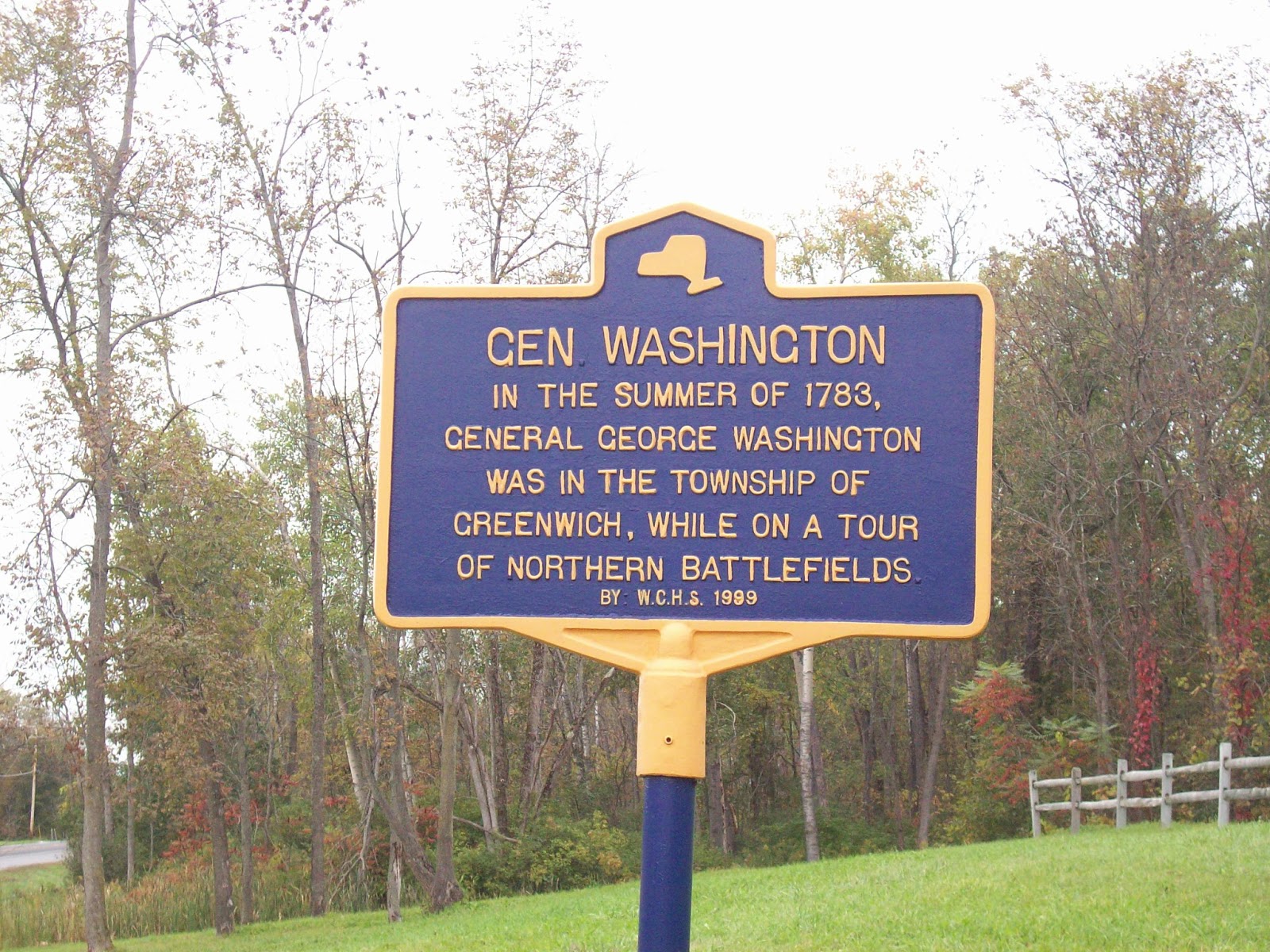
The Washington County Historical Society put up some markers, like the 2 below.

Near Dix Bridge at Hudson's Crossing in Clarks Mills
George Washington marker on US Rte 4 just before County Rte 77

Then we have some other markers. Like the plaque in Battneville put up by the Ondawa-Cambridge chapter of the Daughters of the American Revolution (DAR). It is inserted into a stone wall & is nearly impossible to read from the road. The sign is easier to see, but it is still not a historic marker. Susan B. Anthony & her family need a proper marker at their former home.

"EARLY HOME OF A GREAT WOMAN" the plaque reads

Sign outside the house on Route 29 in the hamlet of Battenville

& what about those brown & white markers? Aside from being ugly, they are harder to read than the blue & yellow ones. Who put these up, & when?

Not a very descriptive marker- along US Rte 4 near the Washington marker

Located at the intersection of County Rte 77 & Lick Springs Rd

The long & short of it is that we could erect some more historic markers in the town without shelling out our hard earned cash. The William G. Pomeroy Foundation has an historic roadside marker grant program. Starting on August 1, 2013 the grant application will be available for our region (APHNYS Region 5). If we choose a site or 2, & provide all of the necessary paperwork, we could receive the funding.

Any ideas? I was thinking the Anthony home in Battenville, the Main St. former site of the Free Church, founded in 1937 by Hiram Corliss, or the site of Union Village Academy.


Friday, June 7, 2013

Brief history of Eddy Plow

A few years back I received an email with pictures of an Eddy Plow. The owner felt the need to paint (gasp) the metal & display it on their lawn. (BTW... don't paint antiques/ historical pieces until you talk to an expert.) The second image shows the business stamp. "___ Plow Co Greenwich N.Y."

Plow in question

Plow from Greenwich, NY

Perry Miller was the first to manufacture plows in the Greenwich/ Easton area. According to Mrs. B.F. Sharpe, in History of Greenwich NY, Mr. Miller "made the second cast-iron plow in the country" (p. 12). By 1830 his sons Hill & David were no longer in the plow business.

Enter Corinth (Saratoga County) native Walden Eddy (b. 1807). Mrs. Sharpe writes on pages 12-13
In 1832 Walden Eddy began the manufacture of plows, having a pattern which became justly celebrated afterwards  as the old "Rough and Ready wrought iron beam," and it is believed that from this source have originated all the wrought-iron plow-beams in the country. Mr. Eddy also invented a shovel plow that has large sale.
 The plow works was located in the village of Greenwich (at the time of founding, Union Village), but on the town of Easton side along the Battenkill. The three-story building still stands & has been renovated recently by Patrick Brereton.

In an article from the Greenwich Journal, date January 19, 1983, the population of the town is listed at about 1,000 when Eddy started making plows in 1832. Lack of convenient shipping (no canal on the Battenkill, no railroad until 1870), & lack of the latest technology are lists as reasons for the floundering foundry with Mr. Dyer. Enter Abram Reynolds, & a few years later, Samuel Langdon. Eddy, Reynolds & Langdon did rather well & then Mr. Eddy bought out the other 2 men. I'm assuming this was so he could bring his sons into the fold, because in 1881 Oscar H., Walden G., & Fred W. entered the business, & the name was changed again to W. Eddy & Sons.

Based on this same article, it appears that the present three-story Eddy Plow building was build in 1892 with 60 feet of frontage to Eddy St & incandescent, electric lights powered by their own plant. It even has a full basement "considered one of the finest in Washington county." The building had a showroom, moulding room, plow mounting & grinding room, as well as blacksmith, forge, machine paint & finishing shops. The article says the plow work employed 40 men including William McCall (head of the moulding room) & W.T. Liddell (business manager).

Apparently the "rough & ready" trademark is "NO. 4 s". In 1891 they introduced a steel reversible level land plow, & in 1892 a one horse plow with patent draft rod, perfect for gardening, & orchards. They were also selling an improved marker for corn & potatoes, a hilling plow, also for potatoes, rye thrasher, land roller, & horse hoe & cultivator, among other things. At one point they even made & sold bicycles.

Eddy Plow Works Calendar 1931

In 1908 the business was incorporated . A major fire in 1918 cut production & business fell off. On October 10, 1923, the Greenwich Journal reported that the W. Eddy Plow Company filed for bankruptcy at the federal court in Utica, NY.The fire had hurt business, but the Great Depression mad matters worse. Liabilities were listed at $79,072 (using the Consumer Price Index this is the equivalent of $1,060,000 in 2012). According to the Greenwich Journal, the plow works was sold at auction in December 1923 to Mac Finn of Saratoga Springs, NY for $16,500.

References:
"W. Eddy & Sons: An Enterprise of Greenwich Sixty- Years Old, The largest Implement Manufacturers and Dealers in Eastern New York." Greenwich Journal. January 19, 1893. 
"Plow Company Files Bankrupcy Petition." Greenwich Journal. October 10, 1923.
"Mac Finn Purchaser of Eddy Plow Plant." Greenwich Journal. December 19, 1923.
Gill, I.V.H. The Greenwich Community of 1850. 1953.
Sharpe, B.F. History of Greenwich. Greenwich, NY: Commonweal Press. 1909.
Tefft, Grant. The Story of Union Village, Volume 1. Greenwich, NY: Greenwich Journal. 1942